Local SEO For Drug Rehab Centers? How to Use Local SEO To Drive Admissions
Contents:
1. Pitfalls of Rehab Center SEO
2. Why Local SEO for Rehab Centers?
3. Local SEO Rank Factors for Rehab Centers
4. Steps For Local SEO
5. Tracking SEO For Rehab Centers
6. Attribution
How Local SEO Works For Rehab Centers:
If your treatment center isn’t focusing on Google Business Profile: you’re leaving admissions on the table. In fact, it’s not uncommon for over 50% of addiction treatment admissions to come from Google Maps, the Local Map Pack, or Local Finder.
Local SEO for rehab centers is your most powerful growth engine. And while it might not seem intuitive, I’ve seen facilities double admissions just by shifting their SEO strategy from a statewide focus to a hyperlocal focus. I’ve also seen centers with solid call numbers make the wrong strategy pivots because they didn’t have the right attribution or tracking in place.
So, if your treatment centers is serious about growing admissions organically and doing it the right way, this guide is for you. We all know Google Ads isn’t sustainable in this space (it’s insanely expensive). If you apply some of the tips below, you’ll be able to generate more drug rehab leads with far lower spend!
Rather listen instead? You can hear all of the following tips and more on Sam’s interview on the Recovery Reach Podcast:
Why Most Treatment Center SEO Strategies Miss the Mark
It’s common for addiction treatment centers to want to rank statewide—or even nationally. After all, people travel for care, right?
Yes, but here’s the truth:
Local intent search = Map Pack first.
And if you’re not in the Map Pack, you’re not the first (or second, or third) thing people see.
If someone in Columbus searches for “medical detox near me”, they’re going to see three local results in a map. Even if your facility ranks #1 organically, it’s still showing up below those three. On mobile, that means you’re off the screen—and out of sight means out of mind.
The Pitfall of “Going Statewide”
Focusing too broadly means:
- You lose local relevance
- You miss the Map Pack
- You don’t win statewide or locally
When I was the digital marketing director for a multi-location facility in Ohio, we shifted from statewide to city-first. The result? 12–15% year-over-year growth in call volume without additional spend.
Why Local SEO Strategy Wins For Drug Rehab Centers
Most rehab centers default to the same instinct: rank statewide, cast a wider net, fill more beds.
The problem? Statewide rankings don’t exist in local search.
Search “rehab centers [your state]” right now. You’ll see rehab centers near you — not the best-reviewed center in the state, not the largest, not the one with the most service pages about that state. The Map Pack always appears first for searches like this, and nobody ranks in the Map Pack in an entire state at once.
The Map Pack runs on three things: proximity, prominence, and relevance (all measured relative to where the searcher is standing at the moment that they search).
Same keyword. Completely different results. Here’s what that looks like when you search “Ohio rehab centers” from Cincinnati versus Cleveland:
Cincinnati:
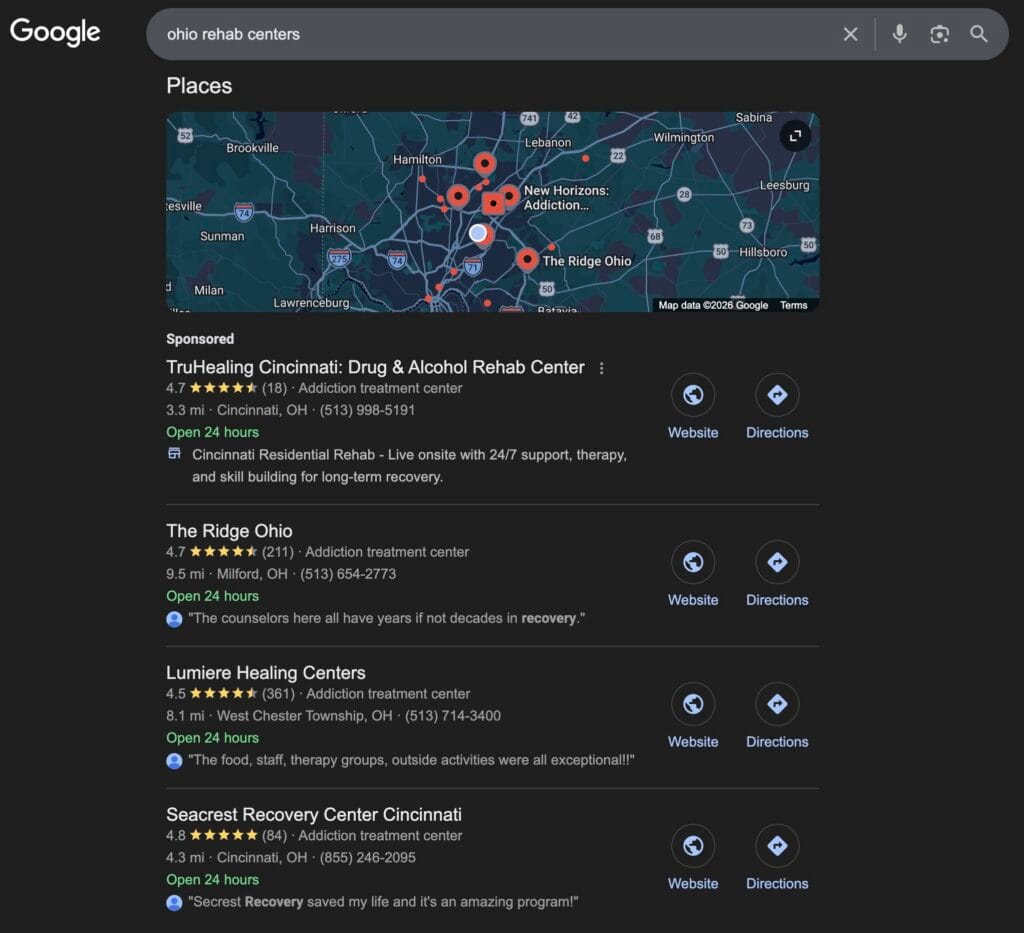
Cleveland:

The winners here aren’t optimizing for Ohio. They’re optimizing for their city.
This matters even more for drug rehab centers because Google Ads in this vertical are brutally expensive. For brick-and-mortar facilities like residential programs, detox centers, PHPs, IOPs, and outpatient clinics: local SEO is almost always the highest-ROI channel available. Here’s why:
Speed to results: Local SEO moves faster than national SEO because you’re competing in a defined geographic pool, not against every treatment center in the country. Even a brand-new facility can appear in the Map Pack quickly with the right fundamentals in place.
Zero-click calls: In local search, users routinely find a GBP listing, read a handful of reviews, and call — without ever visiting a website. Those calls don’t appear in your analytics as organic traffic. But they’re your highest-value conversions.
It’s winnable: Dominating a city or neighborhood is genuinely achievable for most facilities, even against larger competitors, if you execute the basics correctly. Ranking nationally against well-funded aggregators is not.
Admit-ready intent: Someone searching “detox near me” or “IOP in Columbus” isn’t browsing. They’re ready to act. These searches convert at a fundamentally different rate than broad informational queries, and no amount of statewide content strategy captures them.
The 3 Local SEO Rank Factors For Rehab Centers
Local SEO for rehab centers relies on three core ranking factors: distance from the searcher, relevance to the search term, and prominence. Understanding these is critical:
1. Distance
You can’t fake this. Google prioritizes proximity. If your facility is in West LA, you won’t show up in the Map Pack for East LA unless you do some serious lifting (or move).
2. Relevance
This is all about your content. If you want to rank for “Residential Rehab in Los Angeles”, you need a page that says exactly that. “Residential Treatment” alone won’t cut it.
Quick Tip: Put your city in the H1s, title tags, and slugs.
“Medical Detox”–> “Medical Detox Phoenix”
“IOP” –> “IOP Program Los Angeles”
3. Prominence
This is your authority. It’s built from:
- Reviews (especially on Google)
- Branded searches
- Driving directions requests
- Media mentions
- Backlinks
- Social presence
Google tracks how many people are engaging with your brand—even before they click your website. So yes, even PR and brand awareness campaigns can help in Local SEO.
How to Rank Drug Rehab Centers With Local SEO:
These aren’t fluff. These are proven strategies we implement at Hoopless to help our treatment center clients dominate their local markets:
1. Optimize Your Google Business Profile (GBP)
- Fill out every field (yes, even the ones buried under “Info” and “Services”)
- Use at least 5 categories, up to 10 if relevant
Examples: Addiction Treatment Center, Alcoholism Treatment Program, Mental Health Service, Psychiatric Hospital, Counselor, Psychiatrist, Psychologist - Add all relevant services—especially the ones Google auto-suggests in GBP
- Use a dedicated tracking number (see below)
- Add images, description, and hours
- Embed driving directions on your website for each location
2. Use Service Area Pages (The Right Way)
Want to rank just outside your physical location? Build dedicated location pages for nearby neighborhoods or towns. But don’t pretend you’re located there (Google hates that, and so do users).
Example:
Page Title: “Addiction Treatment near Smithfield”
Body Copy: “Located just 15 minutes south of Smithfield…”
[Embed Google Maps Driving directions!]
Be honest. Be specific. Use map embeds and driving directions.
3. Build citations:
Citations accross the web are a foundational Local SEO ranking signal. For treatment centers, the citation stack looks different from most other local businesses because there are important industry-specific directories that carry genuine SEO weight.
Universal Citations Every Facility Must Have:
- Google Business Profile (primary — everything else feeds this)
- Apple Maps
- Bing Places for Business
- Yelp
- Facebook Business Page
- Better Business Bureau
Reab Industry Directories:
These carry specific topical authority for addiction and mental health searches and should be a priority for treatment centers:
- SAMHSA’s Treatment Locator: The Substance Abuse and Mental Health Services Administration maintains a government directory of licensed treatment facilities. Being listed here is both an SEO citation and a trust signal that sophisticated searchers actively look for.
- Psychology Today: Heavily trafficked for behavioral health searches. Their therapist and treatment center listings rank independently in Google for local queries.
- Recovery.com: A high-authority behavioral health directory with 150,000+ monthly searches from people actively seeking treatment. Complete, current profiles here drive direct referral traffic in addition to citation value.
- Rehabs.com / American Addiction Centers network: High domain authority in the space.
- FindTreatment.gov: Federal government directory — high authority, trusted signal.
- Addiction Center: Significant organic traffic and backlink authority in the behavioral health vertical.
Tracking: Use Grid Rank Trackers to See the Real Picture
If you’re searching on Google from your treatment center and see your facility in the Map Pack: that doesn’t really mean anything. Because distance is a factor, you’re pretty much always going to rank first for all sorts of keywords from your facility. But two blocks away? That might be a completely different story.

Tools like Local Falcon or Localo show you where you rank across different parts of your city—not just a single search result.
You might be #1 in South Phoenix, but #15 in North Phoenix. That means half your market can’t even see you.
These grid scans give you tactical insight into where to double down or where to build location pages.
Attribution: Don’t Guess Where Your Leads Are Coming From
This is where most treatment centers—and even agencies—get it wrong.
If you’re relying only on Google Analytics or G4 to understand how SEO is performing, you’re missing 60–70% of the picture.
Why?
Because many calls never hit your website.
They come straight from your Google Business Profile.
How to Fix That: Call Tracking Metrics + Dynamic Number Insertion
If you take one technical thing away from this post, make it this.
✅ Use a unique tracking number for your Google Business Profile
This is the only way to track calls that come directly from the Map Pack.
- Use a number not found anywhere else on your site
- It should forward to your main line
- Track it as a separate source in your call tracking platform
✅ Add UTM parameters to your GBP website link
This powers dynamic number insertion (DNI) when someone clicks from GBP and lands on your site.
Example:
https://yourtreatmentcenter.com/?utm_source=google&utm_medium=organic&utm_campaign=gmb
It also will let you track keyword click and impressions in Google Search Console! Just filter by pages and select the URL that shows the UTM parameter. Now you can differentiate homepage traffic from Google Maps traffic.
✅ Use DNI in Call Tracking Metrics (CTM) or CallRail
When someone lands on your site with the UTM above, you can swap the phone number on the page to match the source with DNI.
This tells you:
- They found you through local search
- They clicked your GBP link
- They called after reviewing your website
You now know exactly what part of your SEO strategy drove the call.
What Gets Measured Gets Managed
At Hoopless, we don’t just “do SEO.” We track:
- Map Pack presence across your service area
- Call volume by source (Map Pack vs. website)
- Keyword performance by location
- Click-to-call rate
- Call quality and lead outcomes
If you’re not measuring what matters, you’re probably overvaluing vanity metrics like traffic and rankings—while undervaluing the stuff that’s actually driving revenue.
Step Up Your Treatment Center’s Marketing With Local SEO
Local SEO for treatment centers isn’t about traffic. It’s about calls, admissions, and impact.
If you’ve got a physical location and a solid program, you’re already halfway there. Now it’s time to win the Map Pack (and clients will follow).
How We Help Rehab Centers Grow With Local SEO
At Hoopless, in addition to our proven results in Local SEO – we also have decades of combined experience in the addiction treatment space, from in-house digital marketing roles to admissions consulting and more.
We help residential treatment centers cut waste, identify channels that drive admissions, and execute best-in-class rehab SEO services with a hyperlocal strategy to drive calls and lower CPA.
Our Local SEO plans typically include:
- Market and demographic research
- Patient/client modeling
- Google Business Profile management, optimization, and strategy
- Google Maps spam fighting
- Content development & content strategy
- Branding and design
- Call tracking
- Conversion Rate Optimization (CRO)
- AI / Answer Engine Optimization (AEO)
- On-page and technical SEO
- Multi-location and multi-state strategies
- Growth strategy and reporting
- Competitor research and analysis
- And more
Book a discovery call today to see if you may be a fit for Hoople
Want help implementing all of this?
We build and manage local SEO campaigns specifically for behavioral health and treatment centers. From building beautifully on-brand websites to fully managed SEO and Google Ads campaigns (yes, we help handle LegitScript), you can get a fractional full-service digital marketing department without the added employee overhead.
Reach out today to book a free discovery call.
Why We’re The Trusted SEO Company For Rebab Centers
We’re regularly mentioned and quoted in the most trusted Local SEO publications. In fact, our Co-Founder, Sam Knight, was 1 of 47 Local SEO voices to contribute to the popular 2026 Rank Factors Survey from Whitespark. Check it out here!